
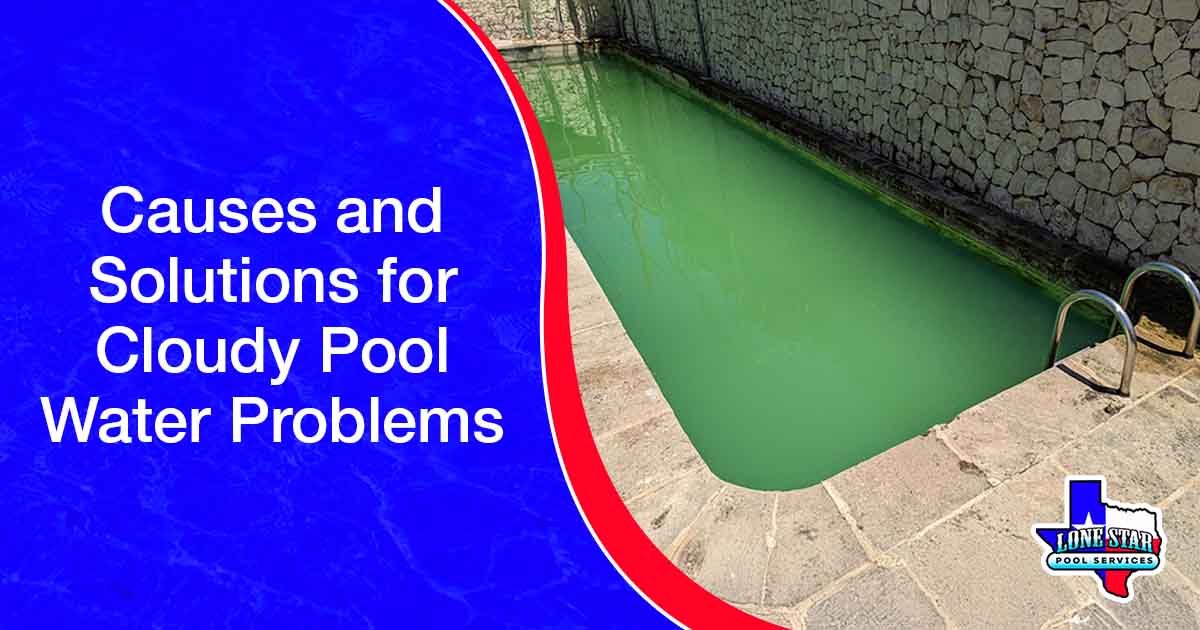
After a long hot day at work, nothing sounds more refreshing than diving into your refreshing swimming pool. You come home, slip into your bathing suit, and step outside, but instead of a sparkling oasis you’re met with cloudy pool water. You may find yourself asking how this could have happened and what you can do to fix it. Don’t worry, the experts at Lone Star Pool Services are here to walk you through fixing this problem.
What causes Cloudy Pool Water?
There are a few different things that can result in cloudy swimming pool water. Often times this occurs when the free chlorine in your pool is depleted after heavy use. A heavy rainfall can also dilute your chlorine and lead to cloudy water. Even the sun’s UV rays can destroy the free chlorine. In almost all cases of cloudy swimming pool water the issue can be traced back to chlorine. This is good news because it’s an easy fix. A simple shock treatment will often restore your pool to the sparkling clear haven it once was.
However, if the water tests come back and show appropriate chlorine levels, there could be other culprits behind your cloudy water. Imbalanced chemicals, filter problems, poor circulation, and environmental debris can all contribute to a cloudy swimming pool. Thankfully, there are things you can do to correct each of these scenarios.
Chemical Imbalance
If you own a swimming pool then you likely understand the delicate chemistry behind keeping it balanced. Yet, sometimes a simple mistake can become apparent as the clarity of your pool water diminishes. Mistakenly using the wrong chemical or an incorrect amount is a mistake almost every pool owner makes at some point.
Testing your pool water can give you a good idea of what went wrong. Pay close attention to the pH, chlorine levels including combined chlorine and total chlorine, total alkalinity, calcium hardness, bromine, and cyanuric acid. Once you can see where the imbalance is you can begin to make corrections.
If the chemicals are balanced but you still have cloudy pool water then it’s likely caused by particles. With everything else as it should be, a water clarifier can easily help gather the particles for collection by the pool’s filter. Another way to clear the particles out of your pool water is using pool flocculant. This chemical grabs hold of the cloudy particles and pulls them to the bottom of your swimming pool. Here, you can easily vacuum them up with your pool vacuum.
Fixing Cloudy Pool Water
Sometimes, fixing cloudy pool water is slightly more complicated than adding pool flocculant and vacuuming up the sinking cloud. A little chemistry comes into play when your pool needs balanced to clear the water.
Chlorine levels should be tested daily. Recommended levels are around 3 parts per million while combined chlorine should come in below 0.5 parts per million. The gap between free chlorine levels and total chlorine levels is directly related to how much combined chlorine, also known as chloramine, is in the pool. When combined chlorine rises over 0.5 ppm then you may notice your water getting cloudy. When this happens, it is also unsafe for swimming.
If you have an outdoor pool and struggle with the sun’s rays depleting your chlorine levels prematurely then try using a chlorine stabilizer. However, be weary and follow the manufacturer’s instructions. Too much chlorine stabilizer such as cyanuric acid can actually result in a cloudy pool and increase your pool’s susceptibility to algae.
I high pH level can also result in cloudy pool water. This is because a high pH results in ineffective chlorine. If your pool’s pH is above 7.8 then you’ll want to use a pH reducer to bring the pH back down to safe levels. Likewise, a low pH can also cause cloudy water due to increased bacteria and algae. In this case you’ll want to use a pH increaser to raise the level to at least 7.4. It’s also important to keep an eye on total alkalinity. This should be between 80 and 120 parts per million.
Help! I Shocked My Pool and Still Have Cloudy Pool Water!
Don’t worry; it’s normal for your water to still look cloudy or milky after you shock your pool. As long as your pump and filter are on and running you’ll be back to a sparkling clean pool in about a day. If your water is still cloudy twenty four hours after the shock treatment then you may want to take another look at your chemicals. If you’re using poor quality chlorine shock then it might not be enough to cut it. Test your water again to ensure everything is within the recommended levels and redo the shock with a higher quality product if needed. If you haven’t tried a water clarifier by this point, you may want to consider trying one out.
When nothing else seems to work on your cloudy water problem you may need to triple check your pool’s circulation system. If water isn’t circulating as it should then it can easily become cloudy. All return fittings need to be adjusted enough to allow all of the water to circulate as needed. Depending on how much you use your pool, the filter should run between 10 and 24 hours each day. It’s also a good idea to check your filter to make sure it isn’t blocked. Clean or replace your filter as needed.
When to Ask for Help with Cloudy Pool Water
If you’re unable to correct the problem on your own or if cloudy pool water is a reoccurring issue in your swimming pool, you may want to consult a professional. The experts at Lone Star Pool Services are here to help you with all of your swimming pool needs. Not only can we help get your pool on the right track, but we offer weekly maintenance packages to keep it there. You have a pool for your enjoyment, let us help you get the most out of it.